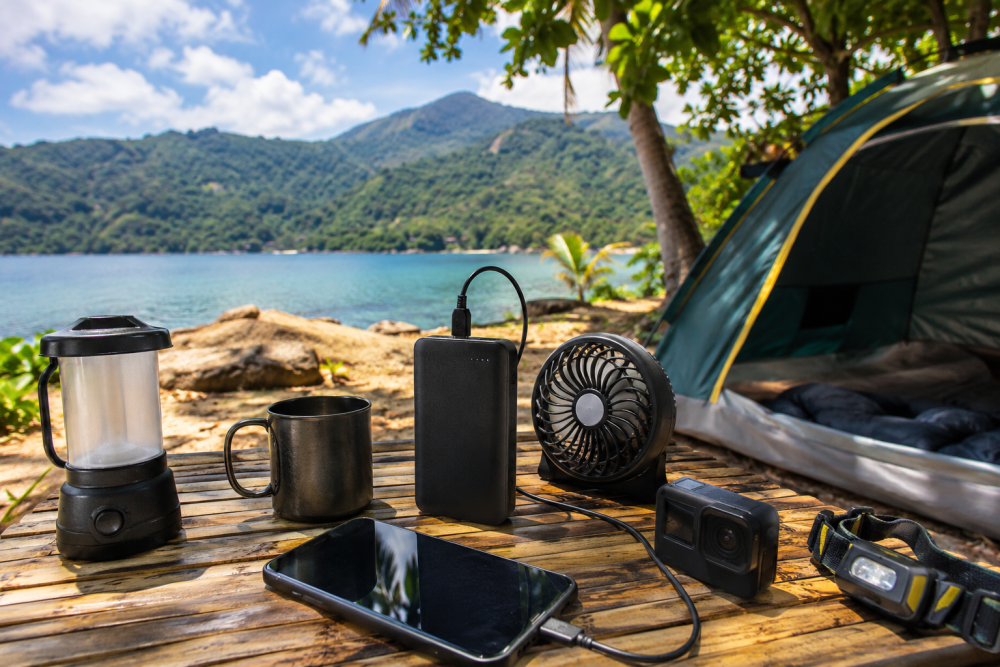

For camping in the Philippines there are two kinds of power, and the right one depends on whether you walk in or drive in. For hikes like overnight climbs, carry a light power bank: a splash-resistant 10,000 mAh model such as the Nitecore NB10000 Gen 2 (150 g, IPX5, about 6,400 mAh at 5 V) covers one phone for two nights in airplane mode, while a 20,000 mAh bank covers a phone plus a headlamp or action camera. For car, beach or family camping with fans and lights, take a small power station: the Anker SOLIX C300 DC (288 Wh, 2.8 kg) or EcoFlow RIVER 2 (256 Wh, 3.5 kg) runs a USB fan through the night and refills from a 100–110W solar panel in about 3 hours of good sun. Small solar panels built into power banks are only a backup: they add a few percent per hour, not a full charge.
Camping Power Datasheet
| Model | Energy / rated output | Water resistance | Recharge options | Size | Weight |
|---|---|---|---|---|---|
| Nitecore NB10000 Gen 2 | 38.5 Wh / 6,400 mAh at 5 V | IPX5 (rain, splashes) | USB-C 18W | 122 × 59 × 10.6 mm | 150 g |
| Xiaomi Power Bank 20000 Integrated Cable | 74 Wh / 13,000 mAh at 5 V | not rated | USB-C | not listed | 342 g |
| Anker SOLIX C300 DC (LiFePO4) | 288 Wh, 3,000+ cycles to 80% | not rated | 140W USB-C, 100W solar (11–28V, XT60), car | 124 × 120 × 200 mm | 2.8 kg |
| EcoFlow RIVER 2 (LiFePO4) | 256 Wh | not rated | AC about 1 h, 110W solar (11–30V, 8A), 100W car | 245 × 214 × 142 mm | about 3.5 kg |
Note the temperature limits too: Anker lists 0–40°C for charging the C300 DC. A station left in full sun on a beach or in a closed car can exceed that, and it will slow or stop charging to protect the battery. For more banks see our high capacity guide.
What the Water Ratings Mean Outdoors
| Rating | Protects against | Good for |
|---|---|---|
| No rating | nothing guaranteed | car or tent use only, inside a dry bag |
| IPX4 | splashes from any direction | light drizzle, wet hands |
| IPX5 | low-pressure water jets, steady rain | hiking in rain, boat transfers with spray |
| IPX7 | short immersion, up to 1 m for 30 minutes | river crossings, accidental drops in water |
Even an IPX5 bank is protected only with its port covers closed or ports dry. Charge inside the tent, and let a wet bank dry completely before plugging in a cable. A cheap zip bag weighs nothing and protects any unrated bank.
How Much Power a Camping Trip Needs
| Device | Typical use per night | Energy | Best source |
|---|---|---|---|
| Phone, mostly airplane mode | photos, offline maps | 5–8 Wh | 10,000 mAh bank |
| Phone, with signal and social media | normal use | 10–15 Wh | 10,000–20,000 mAh bank |
| Headlamp or USB lantern | 3–4 hours | 2–5 Wh | any power bank |
| Action camera | 1–2 batteries | 5–10 Wh | 20,000 mAh bank |
| USB fan, 5 W | 8 hours | about 40 Wh | power station or two 20,000 mAh banks |
| 12V camping fridge | 24 hours | often 300+ Wh | larger station plus solar |
What Solar Really Gives at Camp
Estimate for 4 hours of good sun, a common figure for a clear day once morning and late-afternoon light are excluded, with panels delivering about 70% of their rating after heat, angle and conversion losses.
| Panel | Energy in 4 sun hours | Phone charges (about 15 Wh each) | For a power station |
|---|---|---|---|
| Panel built into a power bank (about 1.5–2 W) | 5 Wh | 0.3 | not useful for a station |
| Small folding USB panel, 21 W | 59 Wh | 3.9 | usually not compatible: stations need 11–28V or 11–30V solar input, not 5V USB |
| Folding panel, 60 W | 168 Wh | 11.2 | 60% of a 288 Wh station |
| Folding panel, 100–110 W | 294 Wh | 19.6 | about a full charge of a 256–288 Wh station |
The first row explains why built-in solar is a backup: a whole sunny day adds roughly one-third of a phone charge. Point folding panels straight at the sun and move them every hour or two; a panel lying flat on sand or half-shaded by a tent loses a large share of its output.
Camp Power Packing Checklist
- Charge every bank and station to 100% the night before, and check the indicator in the morning.
- Pack one short cable per device type plus a spare USB-C cable; cables fail more often than banks.
- Put banks and phones in zip bags or a dry bag, even IPX5 models.
- For a power station, bring the XT60 solar cable and car charging cable; Anker notes the C300 DC does not include a car or solar cable in the box.
- Keep banks out of the tent’s sunny side and out of a closed car during the day.
- Use airplane mode at camp when you do not need signal; searching for a network drains phones fast in the mountains.
Three Typical Cases
Case 1: two-day mountain hike
One phone in airplane mode with offline maps and about 100 photos uses roughly 15 Wh over two days. The Nitecore NB10000 delivers about 32 Wh at 5 V (6,400 mAh), so it covers the trip with room for a headlamp, at 150 g.
Case 2: beach camping with a car, two nights, family of four
Four phones (about 50 Wh), a USB fan running each night (80 Wh) and a lantern (10 Wh) add up to about 140 Wh. A 288 Wh C300 DC covers it without the sun; with a 100W panel it ends the trip almost full.
Case 3: island hopping with boat transfers
Spray and a wet boat floor are the main risk, not capacity. An IPX5 bank in a zip bag, plus a phone in a dry pouch, is the safe setup. Leave power stations on the main island.
Frequently Asked Questions
What size power bank do I need for camping?
For one person on a 1–2 night hike, 10,000 mAh is enough if the phone stays in airplane mode. With a camera, headlamp or normal phone use, take 20,000 mAh. For fans or several people, use a 250–300 Wh power station.
Are solar power banks good for camping?
As a backup only. Their small panels add a few percent per hour of direct sun. A separate 100–110W folding panel with a power station is what actually refills batteries outdoors. Details are in our solar power bank guide.
Can a power station run an electric fan at camp?
Yes. A 5 W USB fan runs all night from a 256–288 Wh station with plenty to spare. A larger AC fan of 40–50 W runs about 4–5 hours.
Is a waterproof power bank necessary?
Not for car camping, but useful for hiking in rain or boat trips. Look for IPX5 or higher, and still keep the ports dry when charging.
How long does a power station take to charge with solar?
In good sun, about 3 hours with a 100–110W panel for a 256–288 Wh station; Anker estimates 3.2 hours for the C300 DC with one 100W panel. Clouds or a poor angle can double that.
Related: solar power bank guide · power bank for brownouts.
Sources: Nitecore NB10000 specifications; Nitecore NB10000 Gen 2 IPX5 rating; Anker SOLIX C300 DC specs and temperatures; Anker SOLIX C300X DC datasheet: solar recharge time and cycle life; EcoFlow RIVER 2 input specifications.

Hi! I focus on power banks, charging systems, and real-world performance — mostly trying to understand why specs don’t always match reality. I enjoy breaking things down in a simple way, even if I overthink them first. In my free time, I hang out with my cat, drink more coffee than I probably should and sometimes forget to charge my phone in time, that is why power banks are my best friends!