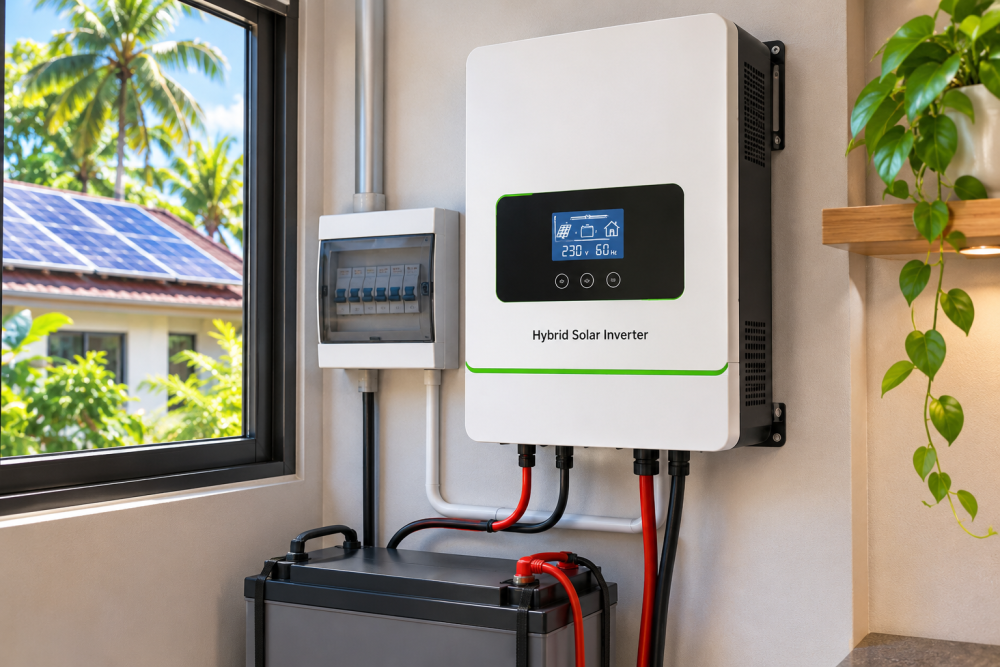

An inverter turns DC power from a battery or solar panels into the 230 V AC your appliances use, and for home backup you have two choices: a pure sine wave inverter or a cheaper modified sine wave one. If you plan to run a refrigerator, an inverter aircon or fan, a laptop or a CPAP machine during brownouts, buy pure sine wave and size it at 1.25 times your total running watts — and at least three times the running watts of any compressor, because a fridge that draws 150 W can pull 600 W for a second when it starts. Pure sine output is as smooth as grid power, so motors run cool and quiet, chargers don’t buzz, and sensitive electronics don’t reset. A modified sine wave inverter costs noticeably less and is fine for LED lights, phone chargers and an electric fan for a few hours, but motors hum and run hotter on it, some laptop adapters overheat, and many inverter-type appliances simply won’t start. Before you pay, check the output label: Philippine outlets supply 220–230 V at 60 Hz, while many inverters on online marketplaces are US models that output 110–120 V.
How an inverter works
Batteries and solar panels produce direct current (DC), which flows in one direction at a steady voltage. Household appliances expect alternating current (AC) that reverses direction 60 times a second in the Philippines. Inside the inverter, fast electronic switches (MOSFETs or IGBTs) chop the DC thousands of times per second, a transformer or high-frequency circuit raises it to 230 V, and a filter smooths the pulses into a sine wave.
Two numbers on the spec sheet matter most. Efficiency — good units turn 90–95% of battery energy into usable AC; the rest becomes heat, which is why inverters have fans. Idle consumption — an inverter switched on with nothing plugged in still draws roughly 10–50 W, enough to drain a small battery overnight, so turn it off when you don’t need it.
Types of inverters and which one fits your home
| Type | How it connects | Best for | Watch out for |
|---|---|---|---|
| Pure sine wave power inverter | battery only | fridge, aircon, laptops, CPAP during brownouts | higher price; size for surge |
| Modified sine wave power inverter | battery only | lights, chargers, short fan use | motors hum and overheat; some devices won’t start |
| Inverter with charger (home UPS-style) | battery + grid outlet | automatic switchover during brownouts | transfer time — look for 10–20 ms or less for desktops |
| Off-grid solar inverter | solar panels + battery | areas with long or frequent outages, farms, rest houses | needs a battery bank sized for night use |
| Grid-tie inverter | solar panels + grid | cutting the electric bill in daytime | shuts off during a brownout for line-worker safety |
| Hybrid inverter | solar panels + battery + grid | bill savings plus brownout backup in one box | most expensive; grid export needs utility approval |
| Microinverter | one per solar panel | roofs with partial shade | higher cost per watt; no battery on its own |
Don’t confuse a power inverter with “inverter” appliances. An inverter aircon or refrigerator uses a variable-speed compressor to save electricity — it does not produce power, but it does need clean pure sine output if you run it from a battery.
How to choose the right inverter size
- List every appliance you want to run at the same time and its running watts (on the label or manual).
- Add them up and multiply by 1.25 — inverters should not run near 100% for long.
- Find the biggest starting surge: compressors and pumps need 3–5 times their running watts for a second or two. The inverter’s peak (surge) rating must cover it.
- Pick the battery voltage: 12 V is practical up to about 1,000–1,500 W, 24 V up to about 3,000 W, and 48 V above that — higher voltage means thinner cables and less heat.
- Choose pure sine wave unless the list is only lights and chargers.
Here is a typical brownout setup for a small Philippine household:
| Appliance | Running watts | Starting surge | Note |
|---|---|---|---|
| 3 LED bulbs | 27 W | 27 W | no surge |
| Electric stand fan | 50 W | ~100 W | runs cooler on pure sine |
| Wi-Fi router + fiber modem | 20 W | 20 W | keeps internet and work calls alive |
| Refrigerator (single door) | 120 W | ~600 W | the surge sets the inverter size |
| 32-inch LED TV | 60 W | 60 W | optional |
| Laptop charging | 65 W | 65 W | pure sine avoids adapter heat |
| Total | 342 W | ≈ 880 W peak | → 1,000 W pure sine wave, 12 V or 24 V |
Leave high-wattage heat appliances — rice cookers, kettles, irons, hair dryers — off the backup circuit. A single rice cooker can draw 600–700 W and will empty a home battery faster than everything above combined.
Battery and runtime: how long will it last
Runtime = battery voltage × amp-hours × usable depth of discharge × inverter efficiency ÷ load in watts. For a 12 V 100 Ah LiFePO4 battery (1,280 Wh) running the 342 W setup above at 90% efficiency and 90% usable capacity, that is about 3 hours. The same size lead-acid battery should only be discharged to about 50%, so it gives roughly 1.6 hours — and its life shortens quickly if you drain it deeper. If your area has 4–8 hour rotational brownouts, plan for 2–3 kWh of lithium storage or a portable power station; for routers and phones alone, a large power bank is often enough — see our guide to a power bank for your router.
Checklist before you buy an inverter in the Philippines
- Output 220–230 V, 60 Hz — not 110–120 V.
- Continuous rating covers your total running watts × 1.25, and peak rating covers the largest surge.
- Built-in charger and AVR if it will recharge from the grid between brownouts.
- Transfer time of 10–20 ms or less if it must keep a desktop PC or modem running without a reboot.
- MPPT solar input if you plan to add panels later; check the maximum PV voltage.
- Protections: low-battery cut-off, overload, short-circuit, over-temperature and reverse-polarity.
- Proper cables and a DC fuse sized for the current: a 1,000 W inverter on 12 V draws about 90–100 A from the battery.
- Local warranty and service — shipping a heavy inverter abroad for repair can cost more than a new one.
A grid-tie or hybrid inverter that exports power to the grid must be installed by a licensed electrician and approved by your distribution utility. Under the Philippines’ net metering program, households and businesses with systems of up to 100 kW can get credits on their bill for exported solar energy — ask your installer to handle the application with Meralco or your local electric cooperative.
Frequently asked questions
What does an inverter do in a house?
An inverter converts DC electricity from a battery or solar panels into 230 V, 60 Hz AC — the same kind of power that comes from the wall outlet — so you can run lights, fans, a refrigerator or a router during a brownout or from solar power.
What size inverter do I need for a refrigerator?
Size it for the starting surge, not the running watts. A typical home refrigerator runs at 100–150 W but needs about 3–5 times that for a second when the compressor starts, so a 1,000 W pure sine wave inverter is a safe minimum for a fridge plus a few small loads.
Is a pure sine wave inverter really necessary?
For anything with a motor or compressor, laptops, inverter-type appliances and medical devices such as CPAP machines — yes. A modified sine wave inverter is fine only for LED lights, phone chargers and simple heaters; motors run hotter and noisier on it.
How long will a 100Ah battery run an inverter?
Multiply volts by amp-hours to get watt-hours, then account for inverter losses and usable depth of discharge. A 12 V 100 Ah lithium (LiFePO4) battery powers a 300 W load for roughly 3.5 hours; a 12 V 100 Ah lead-acid battery, which should only be discharged to about 50%, lasts roughly 1.8 hours.
Can I use a 110 V inverter in the Philippines?
No. Philippine outlets supply 220–230 V at 60 Hz. Many inverters sold on online marketplaces are built for the US and output 110–120 V, which will not run local appliances properly and can damage them. Check that the output is 220–230 V before you buy.
What is the difference between a hybrid and an off-grid inverter?
An off-grid inverter works only from batteries and solar panels. A hybrid inverter also connects to the grid: it can charge batteries from the grid, switch automatically during brownouts and, with the utility’s approval, export solar power under net metering.
Sources: Power Philippines — ERC amended net metering rules; Netcodex — example of a 230 V inverter with charger sold in the Philippines.

Hi! I focus on power banks, charging systems, and real-world performance — mostly trying to understand why specs don’t always match reality. I enjoy breaking things down in a simple way, even if I overthink them first. In my free time, I hang out with my cat, drink more coffee than I probably should and sometimes forget to charge my phone in time, that is why power banks are my best friends!