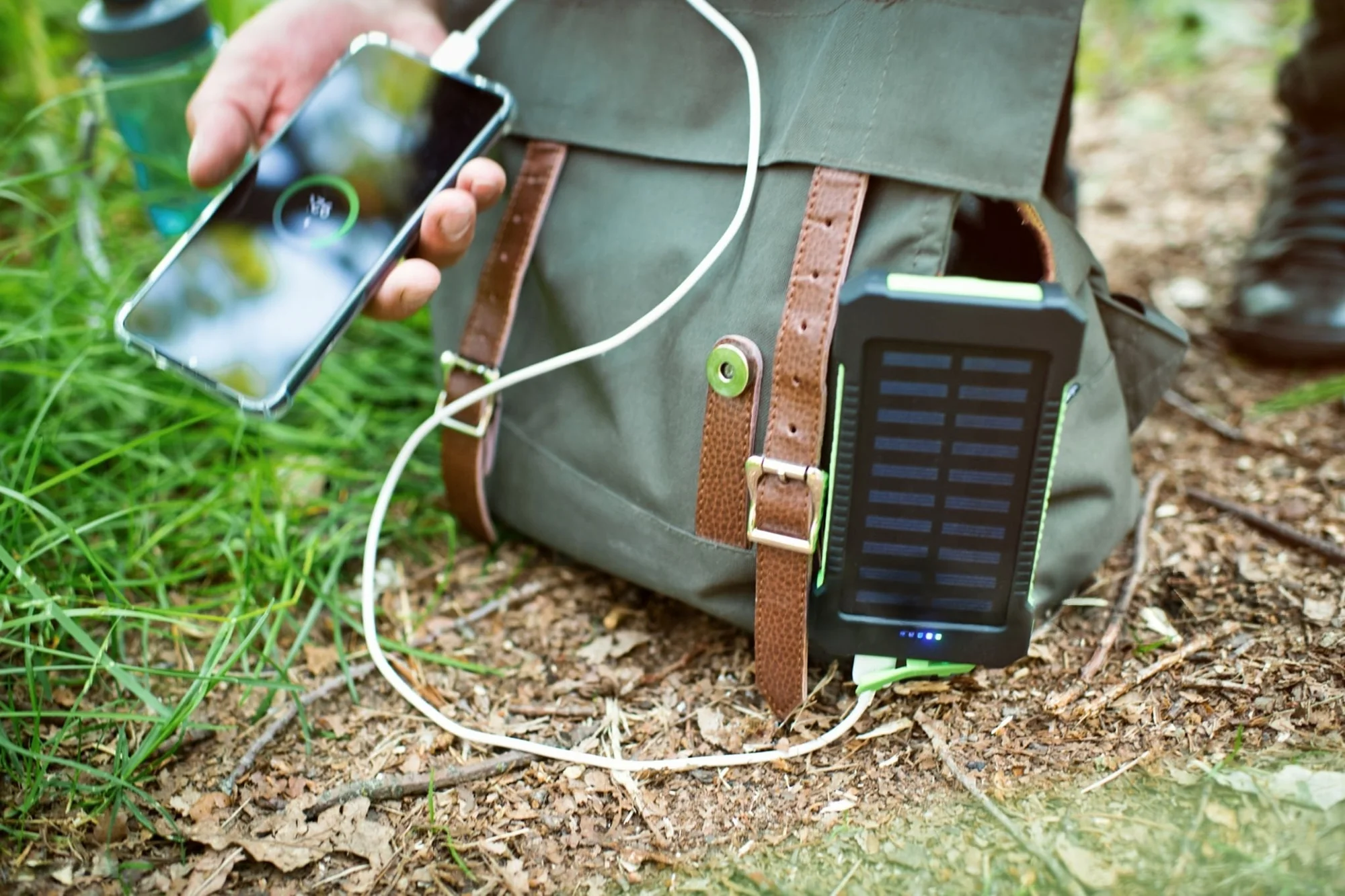

A solar power bank can recharge itself in the sun, but in practice there are two very different products: power banks with a small built-in panel, and separate folding panels of 20–100W. If you want a bank for everyday use that can also take emergency sun, a built-in panel is fine, but treat it as a trickle: a 1.5 W panel needs about 30 hours of direct sun to fill a 10,000 mAh bank, which is about a week of sunny days. If you really need solar to keep phones running during a long outage or a camping trip, get a folding panel instead: even a fold-out 7.5 W bank cuts the time to about 12 hours, and a 100W panel such as the Anker 625 can charge a phone directly over USB-C at 15W or fill a power station in about 3 hours. Always charge any solar bank to 100% from the wall before you need it, and keep the panel side clean: dust and salt spray from a beach trip visibly cut what small panels produce.
Solar Power Bank Datasheet
| Model | Battery | Solar panel | Solar charge time (maker) | Wall charge | Extras |
|---|---|---|---|---|---|
| Sandberg Outdoor Solar Powerbank 10000 (420-53) | 10,000 mAh / 37 Wh | 1.5 W (5V 300mA) | about 30 h of sun | about 2 h on USB-C 18W | PD 20W output |
| BLAVOR Solar 10000 (PN-W05) | 10,000 mAh / 37 Wh | up to 0.23 A, 1.15 W | not stated | USB-C | 20W PD, Qi wireless, IPX5, about 264 g |
| Sandberg Solar 6-Panel Powerbank 20000 (420-73) | 20,000 mAh / 74 Wh | 7.5 W, six fold-out panels | about 12 h of sun | about 5 h on USB-C 18W | fold-out panels |
| Generic 20,000 mAh, 5.5V 300mA panel | 20,000 mAh | about 1.65 W | about 75 h of sun | 4–5 h on USB-C | 10W wireless |
| Promate EcoLight 20000 | 20,000 mAh | 5.5V 145mA (about 0.8 W) | about 110 h of sun | 4–5 h on USB-C | built-in cables |
| Anker 625 Solar Panel (separate) | no battery | 100W, 23% cells | fills a 256–288 Wh station in about 3 h | n/a | USB-C 15W + USB-A 12W, 5 kg |
The pattern is easy to see: solar time depends on panel watts, not on battery size. A bigger bank with the same 1.5 W panel simply takes twice as long. If a listing gives no panel rating in watts or in volts and milliamps, assume it is one of the small ones.
What a Day of Philippine Sun Really Gives
Assuming about 4 hours of strong, direct sun and 70% of the panel rating reaching the battery after heat and angle losses.
| Panel | Energy per sunny day | Phone charges per day (about 15 Wh each) | Best use |
|---|---|---|---|
| Built-in 1–1.5 W | about 3–4 Wh | about a quarter | emergency only |
| Fold-out 7.5 W | about 21 Wh | about 1 | light camping, 1 person |
| Folding 21 W USB panel | about 59 Wh | about 4 | family phones during outages |
| Folding 100W panel + power station | about 280 Wh | about 18, or a modem all day | long outages, camp base |
Reading a Solar Power Bank Listing
| Spec on the listing | How to convert it | What to expect |
|---|---|---|
| Solar panel 5V 300mA | 5 × 0.3 = 1.5 W | about 30 h of sun per 10,000 mAh |
| Solar panel 5.5V 145mA | 5.5 × 0.145 ≈ 0.8 W | over 100 h per 20,000 mAh |
| Solar panel 7.5 W (fold-out) | already in watts | about 12 h per 20,000 mAh |
| “90,000 mAh” or “300,000 mAh” solar bank | check weight: real 20,000 mAh is 340–500 g | almost certainly far less capacity |
| IPX4 / IPX5 / IP67 | water resistance level | IPX5 survives rain; IP67 survives a dunk |
| Solar charging time not listed at all | divide battery Wh by panel W | the honest number the seller left out |
Our 50,000 mAh guide explains the weight check in detail; the same rule applies to solar banks, which are often sold with inflated capacity numbers.
How to Get the Most From a Solar Bank
- Point the panel at the sun, not at the sky. Tilt it toward the sun and turn it every hour or two; a panel lying flat in the late afternoon gives a fraction of its rating.
- Avoid glass. A bank behind a car windshield or window gets far less light and much more heat.
- Keep it cool. Panels and batteries lose output when hot; Anker rates its 625 panel for up to 60°C, but the battery inside a power bank is usually limited to around 35–45°C for charging.
- Charge the bank, not the phone, from small panels. A 1 W panel cannot keep up with a phone’s demand and will just start and stop.
- Use solar for low-power devices such as headlamps, earphones and GPS trackers, where a few Wh matter.
Three Typical Cases
Case 1: after a typhoon, no power for four days
Two phones use about 30 Wh a day. A built-in 1.5 W panel supplies about 4 Wh a day, so the bank empties after the first two days and never catches up. A 21 W folding USB panel covers both phones with spare energy; a 100W panel with a station also runs the modem, as in our brownout guide.
Case 2: a week-long camping trip in Mindoro
One person, phone mostly in airplane mode, about 8 Wh a day. A fold-out 7.5 W bank keeps up on sunny days; on cloudy days it falls behind, so start with a full 20,000 mAh. More setups are in our camping power guide.
Case 3: the solar bank that “stopped charging”
A bank left on a sunny dashboard shows no charging. Most banks stop charging above their temperature limit to protect the cells. Moving it into shade and using the wall charger fixes it; the heat, not the panel, was the problem.
Frequently Asked Questions
Do solar power banks really work?
Yes, but slowly. A typical built-in panel of 1–1.5 W needs 30 hours or more of direct sun to fill a 10,000 mAh bank. It is useful as an emergency top-up, not as the main way to charge.
How long does a solar power bank take to charge in the sun?
Sandberg lists about 30 hours of sun for its 10,000 mAh model with a 1.5 W panel and about 12 hours for a 20,000 mAh model with 7.5 W of fold-out panels. Generic 20,000 mAh banks with tiny panels list 75–110 hours.
Is a solar power bank good for brownouts?
Only if the outage lasts days and you have no other way to charge. For regular rotational brownouts, a normal 20,000 mAh bank charged from the wall is cheaper and faster.
Can I charge my phone directly from a solar panel?
From a folding panel of 20W or more, yes; the Anker 625 has a 15W USB-C port. From a small built-in panel, no; it is too weak to keep a phone charging.
Can I bring a solar power bank on a plane?
Yes, under the same rules as any power bank: carry-on only, under 100 Wh without approval. Most 10,000 and 20,000 mAh solar banks are 37–74 Wh.
Sources: Sandberg Outdoor Solar Powerbank 10000 quick guide; Sandberg Solar 6-Panel Powerbank 20000 quick guide; BLAVOR PN-W05 solar panel rating; Promate EcoLight 20000 specs; Anker 625 Solar Panel specs.

Hi! I focus on power banks, charging systems, and real-world performance — mostly trying to understand why specs don’t always match reality. I enjoy breaking things down in a simple way, even if I overthink them first. In my free time, I hang out with my cat, drink more coffee than I probably should and sometimes forget to charge my phone in time, that is why power banks are my best friends!