

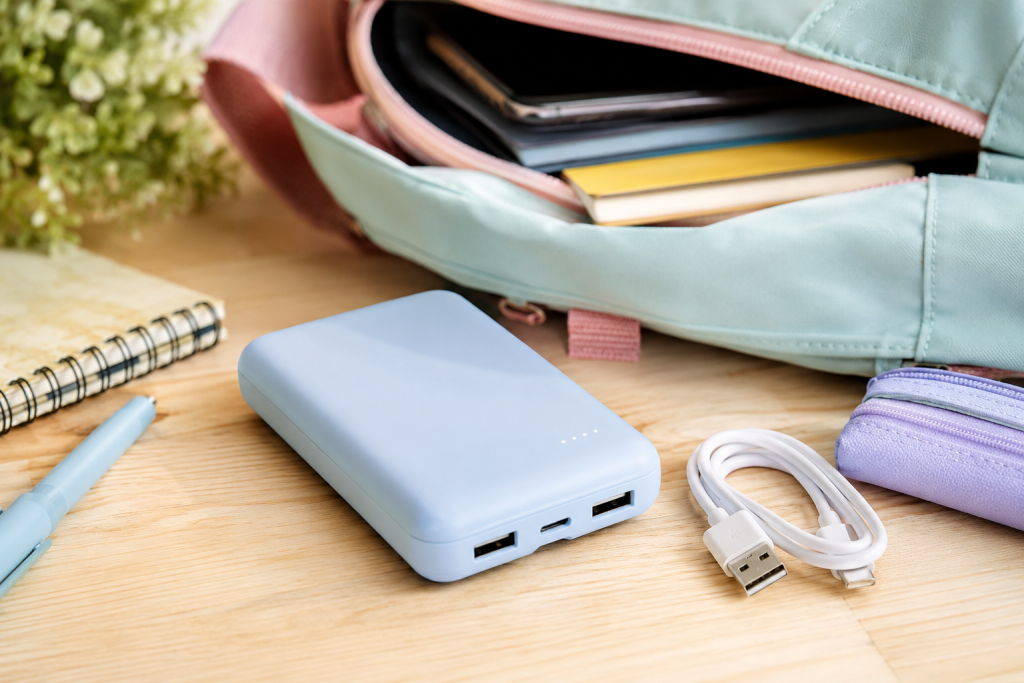
For most kids and students in the Philippines the safest choice is a 5,000–10,000 mAh power bank from a known brand, with USB-C Power Delivery up to 20W and protection against overcharge, short circuit and overheating. That size gives one full charge of a typical phone, weighs 100–220 g in a school bag and costs ₱800–₱1,300 from official stores: for example the Ugreen 10,000 mAh 20W at about ₱799 or the Anker Zolo 10K with a built-in cable at ₱1,195. Skip 20,000–30,000 mAh banks for younger children: they weigh 350–670 g, take 6–15 hours to recharge, and a heavier bank in a crowded bag means more risk if it is crushed. Avoid unbranded ₱150–₱300 banks entirely, because cheap cells and missing protection circuits are the main cause of swelling and overheating. Teach two habits from day one: no charging under pillows or blankets, and stop using any bank that gets hot or bulges.
Which Capacity for Which Age
| Age / use | Recommended capacity | Why |
|---|---|---|
| 7–10, occasional phone or tablet for school | 5,000 mAh with built-in cable | Light, one partial charge, no loose cable to lose |
| 11–14, own phone, daily school days | 10,000 mAh, 20W PD | One full charge; fits a pencil case pocket |
| 15–18, long commute, hotspot, music | 10,000–20,000 mAh | Two charges for heavy use; teens can handle the weight |
| Field trips and family travel | 20,000 mAh carried by a parent | Covers several phones; airline-safe at 74 Wh |
For a younger child, a parent can keep the bank and hand it over when needed; that is often safer than letting it bounce around a bag all day. Older teens who commute alone benefit from a bank with a digital percentage display, so they know when to recharge before leaving home.
Safe Picks Sold in the Philippines
| Model | Capacity / output | Weight | Price seen | Good for |
|---|---|---|---|---|
| Ugreen PB311 | 10,000 mAh / 20W PD | about 210 g | ₱799 (PCX) | Best value for teens |
| Anker Zolo 10K | 10,000 mAh / 22.5W, built-in USB-C cable | about 200 g | ₱1,195 (Anker PH) | Kids who lose cables |
| Xiaomi Redmi 10000 | 10,000 mAh / 10W, two USB-A | about 246 g | ₱650–₱850 | Older phones, tight budget |
| Anker PowerCore Slim 10000 PD | 10,000 mAh / 20W | about 212 g | varies | Thin, fits small bags |
| Branded 5,000 mAh capsule types | 5,000 mAh / 20W | about 100–130 g | ₱600–₱1,200 | Younger kids, emergency |
Detailed reviews: Ugreen, Anker PowerCore Slim 10000. For a bigger family bank, see our Anker PowerCore 20000 review.
The Safety Features That Matter
- Overcharge and over-discharge protection: stops charging at full and cuts output before the cells go too low.
- Short-circuit protection: important because kids carry banks next to keys, coins and metal rulers.
- Temperature protection: reduces output or shuts down when the bank gets hot.
- Quality cells from a known brand, with Wh and model printed on the label.
- A PS mark or a scannable ICC sticker, which DTI-BPS is making mandatory; see our DTI-BPS guide.
Case: A Grade 6 Pupil with a Hand-Me-Down Phone
A common situation: an 11-year-old in Quezon City uses an older Android with a 4,000 mAh battery for school messages and a learning app, and the phone dies by 3 p.m. A 5,000 mAh bank would add roughly 75% charge, enough for the trip home, at about 120 g. A 10,000 mAh bank would cover a full day plus a field trip but doubles the weight. The family chooses the smaller one for school days and keeps a 20,000 mAh bank at home for brownouts, recharged by a parent. The child learns one rule: the bank goes in the outer pocket, never under the lunch box or water bottle.
Habits to Teach Kids
- Charge the bank on a table, never on a bed, under a pillow or inside a bag.
- Unplug it when full, and do not charge it overnight unattended.
- Keep it away from water bottles; a leak in the bag can short the ports.
- Tell a parent at once if it gets hot, smells strange or the case bulges.
- Do not drop it on hard floors; a damaged cell can fail later.
- Use only the cable that came with it or one from a known brand.
School Rules and Practical Tips
Gadget policies differ between schools, and many restrict phone use during class, so check the student handbook before sending a bank to school. Practical steps that reduce lost and damaged banks:
- Write the child’s name on the bank with a label maker or nail polish; white and black banks all look alike in a classroom.
- Pick a bright color, which is easier to find at the bottom of a bag.
- Choose a model with a built-in cable so there is nothing extra to lose.
- Charge it at home every evening after homework, on the dining table, so it is ready by morning.
What Parents Should Avoid
| Avoid | Reason |
|---|---|
| Unbranded banks under ₱300 | Underfilled or recycled cells, weak or no protection |
| Toy-shaped novelty banks with no Wh label | Often uncertified; capacity claims rarely true |
| 30,000 mAh+ for young kids | Heavy, slow to recharge, and banned on Philippine flights over 100 Wh |
| Wireless magnetic banks for younger children | Get warmer than cable charging, especially in hot classrooms |
| Any bank with a dent or swelling | Risk of fire; dispose of it safely |
If a bank stops working, try our not-charging fix before buying a new one, and read our overheating guide for warning signs.
FAQ
What size power bank is best for a child?
5,000 mAh for younger kids and 10,000 mAh for older kids and teens. Both give about one full charge of a typical phone while staying light.
Are power banks safe for kids?
Branded banks with overcharge, short-circuit and temperature protection are safe when used with simple rules: charge on a table, unplug when full and stop using any bank that heats up or swells.
How much does a good power bank for students cost in the Philippines?
About ₱800–₱1,300 for a branded 10,000 mAh bank with 20W charging, such as the Ugreen PB311 or Anker Zolo 10K.
Can kids bring power banks on school trips by plane?
Yes, up to two per person in hand-carry, each under 100 Wh. A 10,000 or 20,000 mAh bank qualifies.
Should children charge power banks overnight?
It is better not to. Charge during the day on a hard surface where an adult can see it, and unplug it when full.
Sources: Anker Philippines power banks; PCX Ugreen power bank listing; Xiaomi Redmi Power Bank 10000 specs.

Hi! I focus on power banks, charging systems, and real-world performance — mostly trying to understand why specs don’t always match reality. I enjoy breaking things down in a simple way, even if I overthink them first. In my free time, I hang out with my cat, drink more coffee than I probably should and sometimes forget to charge my phone in time, that is why power banks are my best friends!