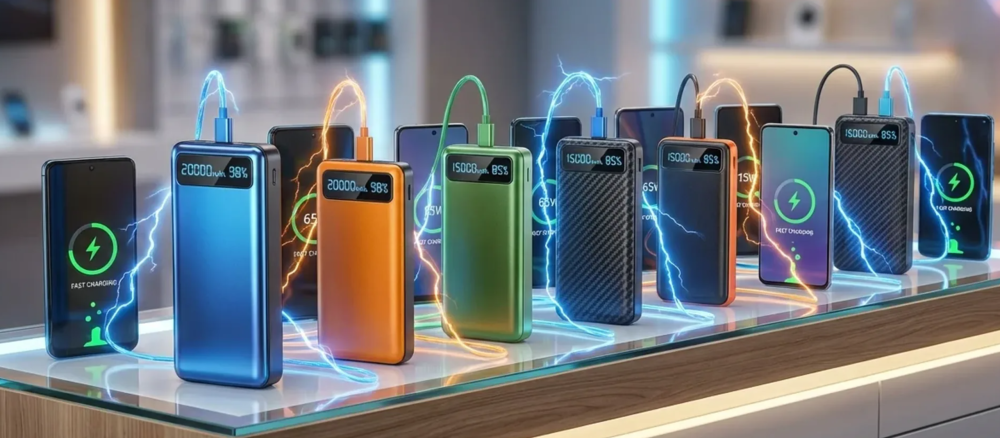

An Android phone charges fast from a power bank only when both speak the same protocol, and there are two ways to get there: a power bank with USB PD and PPS, which covers Samsung and Google Pixel, or a bank that supports your brand’s own system, such as Xiaomi HyperCharge or OPPO’s VOOC. If you use a Samsung Galaxy, choose a power bank that explicitly lists PPS and at least 25W on USB-C: without PPS, Galaxy phones fall back to the older Adaptive Fast Charging at about 15W, so a “30W” bank without PPS charges no faster than a cheap one. Brand-specific banks give Xiaomi, OPPO and realme owners their full speed, but they charge other phones at ordinary PD speeds and cost more. Whatever you buy, use a USB-C to USB-C cable rated for 3A, or 5A for 45W Samsung charging: the cable is often the real bottleneck.
Power Banks for Android: Datasheet
Protocol support is listed only where the manufacturer or its official retail listing states it. “Not stated” means you should check the box or the product page before buying for a Samsung phone.
| Model | Capacity / energy | Max USB-C output | PPS for Samsung | Weight |
|---|---|---|---|---|
| UGREEN Nexode 20000mAh 130W (35524) | 20,000 mAh / 72 Wh | 100W, 130W total | yes (PD, PPS, QC, AFC, FCP listed) | 480 g |
| Baseus Blade 100W 20000mAh | 20,000 mAh / 74 Wh | 100W on both USB-C | yes (PD 3.0 / PPS) | about 490 g |
| Anker 737 Power Bank (PowerCore 24K) | 24,000 mAh / 86.4 Wh | 140W (PD 3.1) | not stated on the product page | about 630 g |
| Xiaomi 33W Power Bank 10000 Pocket Edition Pro | 10,000 mAh / 36 Wh | 33W | not stated; up to 11V 3A on USB-C | about 212 g |
| Baseus Adaman2 30W 20000mAh VOOC | 20,000 mAh | 30W PD, VOOC for OPPO | not stated | not listed |
| Romoss PPU20 130W | 20,000 mAh / 72 Wh | 100W | not stated (PD 3.0) | 500 g |
For phone-only use, any of the first two is overkill in watts but future-proof: they also charge a laptop. For general 20,000 mAh picks across brands, see our best power banks in the Philippines datasheet.
How to Check What Your Phone Actually Gets
- Samsung: while charging, the lock screen says “Super fast charging” (25W) or “Super fast charging 2.0” (45W). If it only says “Fast charging”, the bank or cable is not delivering PPS.
- Xiaomi, Redmi, POCO: the charging animation shows “HyperCharge” or “Turbo” only on Xiaomi-compatible chargers and power banks. On a generic PD bank the phone still charges, just at a lower wattage.
- OPPO, realme: the SUPERVOOC animation appears only with VOOC-certified chargers and banks.
- Any phone: power banks with a display, such as the UGREEN Nexode, show the real wattage. That number is the honest answer, whatever the box promises.
Three Typical Cases
Case 1: Galaxy S user with a “30W” bank that feels slow
The bank delivers 30W over standard PD but lacks PPS. The phone negotiates Adaptive Fast Charging at about 15W, so a 0–50% top-up takes roughly twice as long as on Samsung’s own 25W charger. Replacing the bank with a PPS model fixes it; replacing the cable alone does not, unless the old cable was rated below 3A.
Case 2: Redmi Note owner who expects HyperCharge from any bank
HyperCharge at 67W or more is Xiaomi’s own protocol. From a generic power bank the phone usually charges at 18–33W over PD or QC. That is still fast for a top-up; full HyperCharge speed on the go requires a Xiaomi power bank that supports it, such as the 212W HyperCharge 25000 described in our Xiaomi power bank guide.
Case 3: a 45W Galaxy and a 3A cable
Samsung’s 45W mode needs a USB-C cable rated for 5A. With an ordinary 3A cable the phone caps at 25W even if the bank supports 45W PPS. If you bought a high-watt bank for a Galaxy Ultra, budget for the right cable too.
Capacity: How Many Charges for Popular Android Phones
Most current Android phones have 4,500–5,500 mAh batteries. Using manufacturers’ rated output at 5 V, a 10,000 mAh bank gives about 1–1.2 charges and a 20,000 mAh bank about 2.2–2.6. Phones with 6,000 mAh or larger batteries, common in gaming and budget models, get proportionally fewer. If you want two full charges a day, start at 20,000 mAh; our high capacity power bank guide covers the larger sizes.
Checklist Before You Buy for an Android Phone
| Check | What to look for | Why |
|---|---|---|
| Protocol | PPS for Samsung and Pixel; VOOC or HyperCharge only if you own that brand | decides whether you get top speed or the fallback |
| USB-C output | 25W minimum for current Samsung, 33W+ for Xiaomi and OPPO top-ups | below 20W, most phones charge at standard speed |
| Rated output at 5 V | 12,000 mAh or more for a 20,000 mAh bank | tells you the real number of charges |
| Input wattage | 20W or more on USB-C | a 20,000 mAh bank on 10W input needs most of a day to refill |
| Cable | USB-C to USB-C, 3A; 5A for Samsung 45W | the cable caps the speed before the bank does |
| Certification | DTI ICC sticker, official brand store | fakes rarely support PPS even if the box says so |
Charging Habits That Protect the Phone Battery
- Turn on your phone’s battery protection setting if it has one: Samsung’s “Protect battery” and similar options on other brands stop charging at 80–85%, which reduces wear on a phone you top up several times a day.
- Avoid charging from a power bank while gaming in a hot room or in direct sun. Heat, not fast charging itself, is what ages lithium batteries fastest.
- Top up between 20% and 80% when you can. Short top-ups in this range are faster and kinder to the battery than full 0–100% cycles.
Frequently Asked Questions
Does a power bank need PPS for Samsung?
For Super Fast Charging, yes. Samsung’s 25W and 45W modes use USB PD 3.0 with PPS. Without PPS the phone still charges, but at the slower Adaptive Fast Charging speed of about 15W.
Will a high-watt power bank damage my Android phone?
No. USB PD and other protocols negotiate the power: the phone takes only what it supports. A 100W bank charges a 25W phone at 25W.
Is QC 3.0 still useful in 2026?
Mostly for older Android phones and for the USB-A port. New phones rely on USB PD over USB-C, so for a new purchase prioritise PD and PPS over QC.
Can I use the cable that came with my phone?
Usually yes for 25W. For Samsung 45W you need a 5A-rated USB-C cable, and for brand protocols like SUPERVOOC or HyperCharge the original cable is often required for full speed.
Which capacity should I buy for a gaming phone?
Gaming drains 20–30% per hour on many phones, so a 20,000 mAh bank with PPS or your brand’s protocol is the practical minimum for a long session away from a socket.
Sources: Android Police: Samsung Super Fast Charging and PPS; UGREEN Nexode 130W protocols; Baseus Blade 100W; Anker 737 Power Bank; Xiaomi 33W Pocket Edition Pro specs.

Hi! I focus on power banks, charging systems, and real-world performance — mostly trying to understand why specs don’t always match reality. I enjoy breaking things down in a simple way, even if I overthink them first. In my free time, I hang out with my cat, drink more coffee than I probably should and sometimes forget to charge my phone in time, that is why power banks are my best friends!