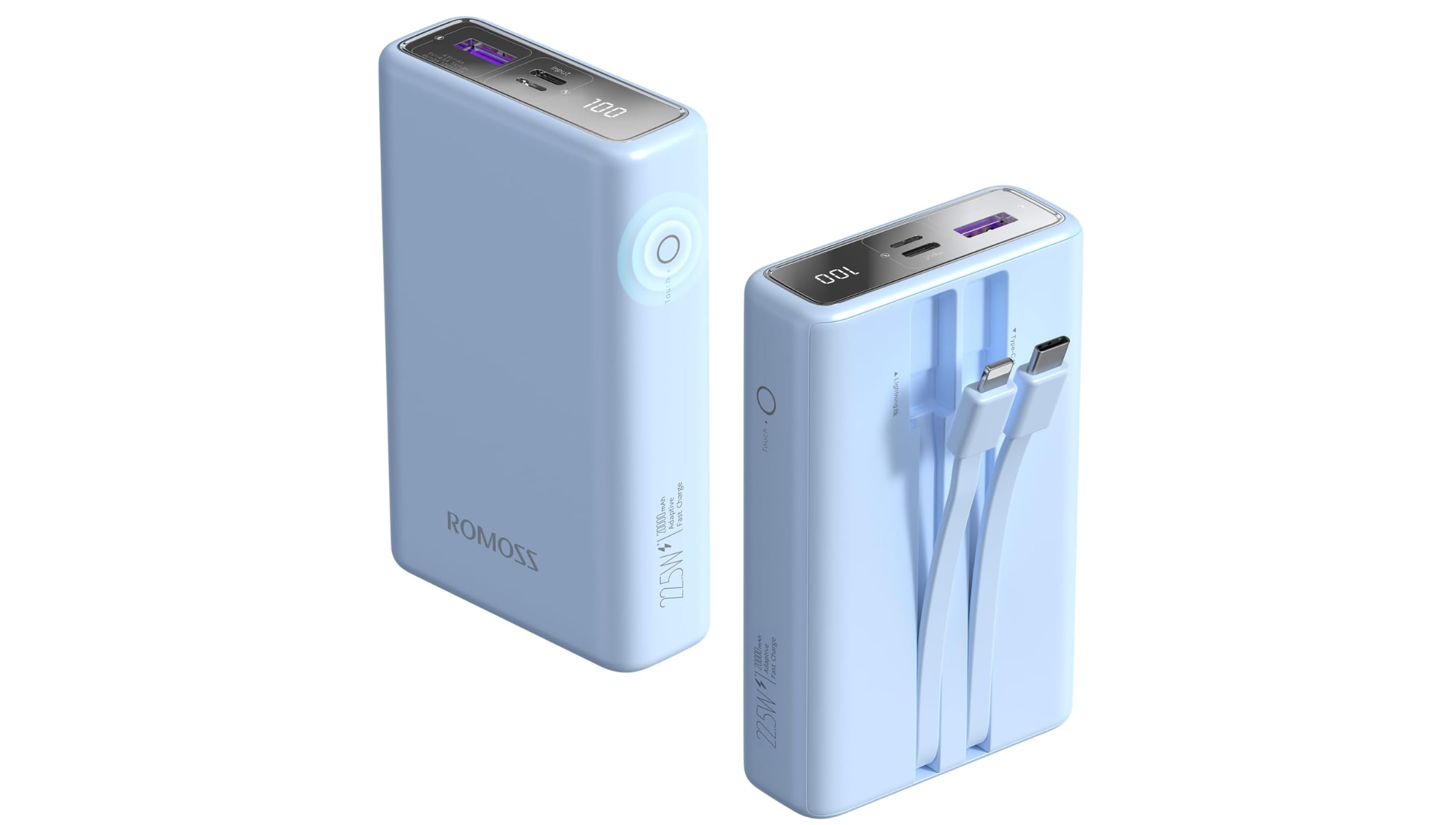

Romoss power banks are good value if you choose a current model, and the brand covers everything from 200 g pocket banks to a 1.3 kg 60,000 mAh brick. For a 10,000 mAh bank, pick the Sense4SF (22.5W, 220 g) or Sense 4S Pro (30W, 245 g) rather than the older Sense 4 Mini, which outputs only 5V 2.1A, about 10W, and charges modern phones slowly. For 20,000 mAh, the PPR20 at 355 g is the light everyday choice, while the aluminum PPU20 (72 Wh, 130W, 500 g) is the Romoss for laptops. Romoss is more open about specs than many budget brands: it prints Wh and, for some models, rated output at 5 V, such as 11,000 mAh for the PPU20 and 18,000 mAh for the 30,000 mAh PEA30. Its weaknesses are weight on older 20,000 mAh models and slow recharging on the biggest ones.
Romoss Power Bank Datasheet
| Model | Capacity / energy | Max output | Input | Size | Weight |
|---|---|---|---|---|---|
| Sense 4 Mini | 10,000 mAh / 37 Wh | 5V 2.1A (about 10W) | 5V 2.1A, Micro-USB or USB-C | 91 × 62 × 23 mm | 202 g |
| Sense4SF | 10,000 mAh / 35.15 Wh rated | 22.5W (PD on USB-C) | USB-C 9V 2A (18W) | 111 × 64 × 25 mm | 220 g |
| Sense 4S Pro | 10,000 mAh | 30W PD | USB-C | not listed | 245 g |
| PPR20 | 20,000 mAh | 22.5W PD 3.0 | USB-C up to 3A | not listed | 355 g |
| PSW20 | 20,000 mAh | 22.5W | not listed | not listed | 463 g |
| SW20S Pro | 20,000 mAh / 74 Wh | 30W | USB-C | not listed | not listed |
| PPU20 (aluminum) | 20,000 mAh / 72 Wh; 11,000 mAh rated at 5V 2A | 130W total, PD 3.0, up to 20V 5A | USB-C up to 3.25A | 153 × 66.5 × 30.5 mm | 500 g |
| PEA30 | 30,000 mAh / 111 Wh; 18,000 mAh rated | 30W | about 5.5 h at 30W | not listed | about 660 g |
| PEA60 (Zeus) | 60,000 mAh / 222 Wh | 22.5W | 18W | 180 × 83.5 × 66 mm | 1,322 g |
The table shows the main Romoss trade-off. Older designs like the Sense 4 Mini and PSW20 are heavy or slow for their capacity; newer ones like the Sense4SF, PPR20 and PPU20 match mainstream brands. Compare with Anker, Xiaomi and UGREEN in our full datasheet.
Capacity and Charges in Practice
| Romoss size | iPhone 15 (3,349 mAh) charges | 5,000 mAh Android charges |
|---|---|---|
| 10,000 mAh (Sense4SF, about 6,000 mAh at 5 V*) | 1.6 | 1.1 |
| 20,000 mAh (PPU20, 11,000 mAh rated) | 3.0 | 2.0 |
| 30,000 mAh (PEA30, 18,000 mAh rated) | 4.8 | 3.2 |
*Romoss lists 35.15 Wh rated energy for the Sense4SF; at 5 V that works out to roughly 6,000 mAh after conversion, similar to other 10,000 mAh banks. Charges include about 10% loss inside the phone. Note that the 30,000 mAh PEA30 is 111 Wh, above the 100 Wh limit, so Cebu Pacific, PAL and AirAsia will not accept it; see our high capacity guide.
Lifespan: How Long a Romoss Lasts
- Cycles. Romoss does not publish a cycle rating for most models. For reference, comparable brands rate their banks at around 500 cycles to about 80% capacity; daily users reach that in one and a half to two years.
- Heat shortens it most. A bank left in a hot car or charged under a pillow ages much faster than one used daily at room temperature; see our overheating guide.
- Storage. Keep a spare Romoss at about half charge and top it up every two to three months; a fully drained bank left for months may not wake up.
- Signs of the end. Fewer charges than before, the display dropping quickly from 100%, warmth while idle, or any swelling. Swelling means stop using it immediately.
Which Romoss for Which User
| You are | Pick | Why |
|---|---|---|
| Student or commuter with one phone | Sense4SF | 22.5W PD at 220 g, about one full charge per day |
| iPhone 15/16 owner who wants top speed | Sense 4S Pro | 30W PD covers the iPhone’s 27–30W limit |
| Two phones or a tablet, daily | PPR20 | 20,000 mAh at 355 g, lighter than the older PSW20 at 463 g |
| Laptop or Steam Deck user | PPU20 | 130W total, up to 20V 5A on USB-C |
| Frequent brownouts, phones only | PEA30 | 111 Wh at about 660 g; stays at home |
| Long outages, many devices, no flights | PEA60 or a power station | 222 Wh; for modems and fans a station is better |
Romoss vs Other Brands
| 20,000 mAh class | Max output | Rated at 5 V | Weight |
|---|---|---|---|
| Romoss PPR20 | 22.5W | not listed | 355 g |
| Romoss PPU20 | 130W | 11,000 mAh | 500 g |
| Xiaomi Power Bank 20000 Integrated Cable | 22.5W | 13,000 mAh | 342 g |
| Vention FKBN0-C | 22.5W | not listed | about 339 g |
In the everyday 22.5W class, the PPR20 sits within about 15 g of Xiaomi and Vention. Xiaomi publishes a higher rated output, while Romoss’s PPU20 adds a laptop-class option with a published rated output, which many budget 100W+ banks do not provide. Compare current prices of the exact models before deciding. See also our Vention and Remax comparisons.
Three Typical Cases
Case 1: student choosing between Sense 4 Mini and Sense4SF
Both are 10,000 mAh and similar in size. The Mini charges a modern phone at about 10W, the Sense4SF at up to 22.5W. For only 18 g more, the Sense4SF roughly halves the time to 50%.
Case 2: brownout backup on a budget
A PEA30 (111 Wh, 18,000 mAh rated) gives about three charges for a 5,000 mAh phone plus spare energy for a USB fan. It stays home, which is fine for brownouts. For running a modem, see our brownout guide.
Case 3: laptop user who wants one bank for everything
The PPU20’s 130W total and 20V 5A USB-C output cover most USB-C laptops. Its weight per Wh is close to the Anker 737’s (72 Wh at 500 g against 86.4 Wh at about 630 g), and its aluminum body and display suit people who want to see exactly how much power is flowing.
Frequently Asked Questions
Is Romoss a good power bank brand?
Yes, for the price, if you pick a current model. The Sense4SF, PPR20 and PPU20 have modern fast charging; older models like the Sense 4 Mini output only about 10W.
How long does a Romoss power bank last?
Typically a few hundred full cycles before capacity drops noticeably, often one and a half to two years of daily use. Heat and storing it empty shorten that.
How many times can a Romoss 20,000 mAh charge my phone?
The PPU20 is rated 11,000 mAh at 5 V, which gives about 2 charges for a 5,000 mAh phone and about 3 for a 3,300 mAh iPhone.
Can I take a Romoss 30,000 mAh on a plane?
Not on Philippine carriers: the PEA30 is 111 Wh, above the 100 Wh limit that Cebu Pacific, PAL and AirAsia apply. The 60,000 mAh PEA60 (222 Wh) is not allowed at all.
Which Romoss is best for iPhone?
The Sense4SF or Sense 4S Pro, which charge over USB-C PD at 20–30W. Older 5V-only models charge iPhones at about 10W.
Sources: Romoss Sense 4 Mini specs; Romoss Sense4SF specs; Romoss Sense 4S Pro; Romoss PPU20 specs; Romoss PPR20 specs; Romoss PEA60 specs.

Hi! I focus on power banks, charging systems, and real-world performance — mostly trying to understand why specs don’t always match reality. I enjoy breaking things down in a simple way, even if I overthink them first. In my free time, I hang out with my cat, drink more coffee than I probably should and sometimes forget to charge my phone in time, that is why power banks are my best friends!
2 thoughts on “Is Romoss Power Bank Good? 9 Models, Real Capacity and Lifespan in the Philippines (2026)”