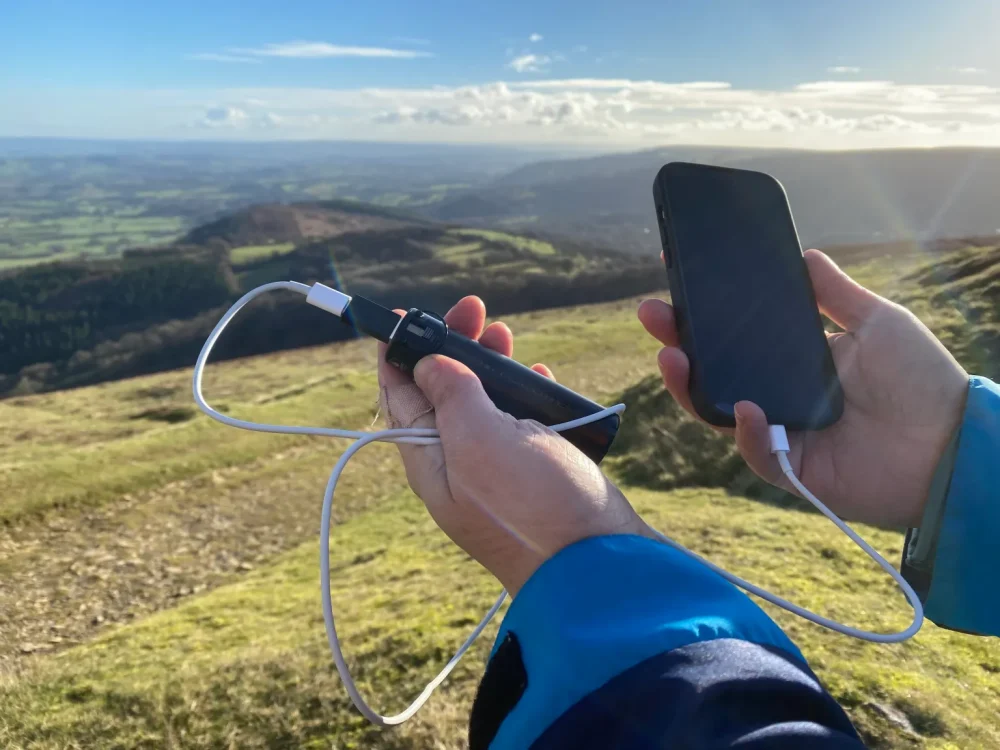

The best power bank for most people in the Philippines is a 20,000 mAh model with 20–22.5W USB-C output, and the main alternative is a 10,000 mAh bank with 30W output. If you are away from a socket for more than 8 hours, ride for work, or need backup during brownouts, choose 20,000 mAh: it delivers about 12,000–13,000 mAh to your phone, which is 2.5 charges of a 5,000 mAh Android phone, and at 74 Wh it is still allowed in your carry-on. The 10,000 mAh class is half the weight (about 215 g for the Anker Nano versus 340–490 g for 20,000 mAh models) and recharges in 1.5 hours instead of 6–7, but gives only about 1.2 charges, enough for a normal office day and no more. Before you buy any model, check the DTI ICC sticker and the weight on the spec sheet: these two details expose most fakes sold online.
Power Bank Datasheet: 9 Popular Models Compared
All figures below come from the manufacturers’ own spec pages and manuals. Energy in Wh is calculated at the 3.7 V cell voltage unless the brand publishes its own figure. “Usable” is the rated output capacity at 5 V where the manufacturer publishes it; where it does not, the cell is marked “not listed” rather than estimated.
| Model | Capacity / energy | Usable at 5 V | Max output | Ports | Recharge | Weight |
|---|---|---|---|---|---|---|
| Anker Nano 10K 30W (A1259) | 10,000 mAh / 37 Wh | not listed | 30W | built-in USB-C cable, USB-C, USB-A | 1.5 h (30W) | 215 g |
| Anker PowerCore Essential 20000 PD (A1287) | 20,000 mAh / 74 Wh | not listed | 20W USB-C, 18W USB-A | USB-C, USB-A | 6.8 h (18W) | 350 g |
| Anker 335 PowerCore 20K (A1288) | 20,000 mAh / 74 Wh | not listed | 20W USB-C, 18W USB-A | USB-C, 2× USB-A | 6.5 h (18W) | 463 g |
| Xiaomi Power Bank 20000 Integrated Cable (PB2020MI) | 20,000 mAh / 74 Wh | 13,000 mAh (65%) | 22.5W | built-in USB-C cable, USB-C, USB-A | 22.5W input | 342 g |
| UGREEN 20000mAh 20W (25683) | 20,000 mAh / 74 Wh | 12,500 mAh (62%) | 20W PD, 22.5W QC | USB-C, 2× USB-A | about 6 h (20W) | not listed |
| Baseus Bipow 20000 20W (PPBD050501) | 20,000 mAh / 74 Wh | not listed | 20W | USB-C, 2× USB-A, micro-USB in | 18W input | 487 g |
| Romoss PEA30 30000mAh | 30,000 mAh / 111 Wh | 18,000 mAh (60%) | 30W USB-C, 22.5W USB-A | USB-C, 2× USB-A, Lightning and micro-USB in | about 5.5 h (30W) | about 660 g |
| Romoss PPU20 130W | 20,000 mAh / 72 Wh | 11,000 mAh (55%) | 100W USB-C, 130W total | 2× USB-C, USB-A | 65W input | 500 g |
| UGREEN Nexode 20000mAh 130W (35524) | 20,000 mAh / 72 Wh | not listed | 100W USB-C, 130W total | 2× USB-C, USB-A | 65W input | 480 g |
Free download: power bank datasheet and calculator (.xlsx)
All nine models with specs from the manufacturers, sortable by capacity, output and weight, plus a calculator: enter your phone’s battery size or your router’s wattage and see how many charges or hours of brownout backup you get.
How to Read a Power Bank Spec Sheet
- mAh on the label is cell capacity, not what your phone receives. The four brands above that publish a rated output capacity lose 35–45% in the 3.7 V to 5 V conversion. Divide your phone’s battery by 0.6 of the label figure for a realistic number of charges.
- Wh decides whether you can fly. Wh = mAh × 3.7 ÷ 1000. Up to 100 Wh is carry-on without approval; 100–160 Wh needs airline approval; above 160 Wh is not allowed. Details are in our power bank flight rules guide.
- Max output matters only if your phone accepts it. An iPhone takes about 20–27W, Samsung’s Super Fast Charging 25W, laptops 45–100W. Extra watts beyond what the device accepts change nothing; see 20W vs 30W vs 65W explained.
- Recharge time is the hidden cost of big banks. A 20,000 mAh bank on an 18W input needs 6–7 hours; on a 65W input, the 130W models refill several times faster.
- Weight is your fake detector. Real 20,000 mAh banks weigh 340–500 g. A “30,000 mAh” bank at 250 g cannot contain the cells it claims.
Which Power Bank for Which Situation
| Your situation | Capacity and output to look for | Detailed guide |
|---|---|---|
| iPhone user, daily commute | 10,000 mAh, 20W+ USB-C PD or MagSafe | Best power bank for iPhone |
| Android phone with 25W charging | 10,000–20,000 mAh with PPS | Best power bank for Android |
| Grab, Lalamove or food delivery rider | 20,000 mAh minimum, 22.5W, built-in cable | Power banks for riders |
| Brownouts and fiber router backup | 20,000 mAh + 12V trigger cable, or a power station | Brownout guide, router guide |
| Laptop on the go | 20,000 mAh, 65–100W USB-C PD | Laptop power banks |
| Pocket carry, light bag | 5,000–10,000 mAh, under 220 g | Slim power banks |
| Camping and outdoor trips | 20,000–30,000 mAh, splash-resistant | Camping power banks, solar power banks |
| Tight budget | 10,000 mAh from an official brand store | Under ₱1,000, price guide |
Three Typical Cases, With the Math
Case 1: a delivery rider runs out of battery by 3 p.m.
A rider uses navigation and the delivery app with the screen on for a 10-hour shift. A phone with a 5,000 mAh battery drains roughly twice in those conditions, so the rider needs about 10,000 mAh delivered to the phone. A 10,000 mAh bank gives about 6,000 mAh, not enough; a 20,000 mAh bank such as the Xiaomi PB2020MI delivers 13,000 mAh according to its spec sheet, which covers the shift with a margin. The built-in cable also saves the most common failure on the road: a lost or broken cable.
Case 2: keeping the fiber router online during a 6-hour brownout
A typical home fiber router draws around 10–12 W, so check the label on its adapter. A 20,000 mAh bank stores 74 Wh. Through a 5V-to-12V trigger cable at about 80% efficiency, that is roughly 59 Wh of usable energy, or about 5 hours at 12 W. For a 6-hour outage you need either a larger bank or a small power station. The calculator in our downloadable datasheet does this math for your router’s wattage.
Case 3: flying out of NAIA with a 30,000 mAh bank
The Romoss PEA30 holds 30,000 mAh at 3.7 V, which is 111 Wh. That is above the 100 Wh limit for carry-on without approval, so the airline must approve it before the flight; at check-in or the gate it can be refused without that approval. A 20,000 mAh model at 74 Wh avoids the issue and still gives 2.5 phone charges, which is why we recommend 20,000 mAh as the maximum for frequent flyers.
Buying Safely in the Philippines
- Check the DTI Import Commodity Clearance (ICC) sticker on the box; how to verify it is explained in our DTI-BPS certification guide.
- Buy from the brand’s official store on Shopee or Lazada (marked Mall or LazMall), not from listings with prices far below the rest of the market.
- Compare the weight and dimensions with the manufacturer’s spec sheet in the table above.
- After purchase, run one full discharge and recharge and note the time; a bank that empties far faster than expected should be returned within the store’s return window.
- For more red flags, see how to choose a good power bank and avoid fakes; if your bank stops charging, start with our troubleshooting guide.
Frequently Asked Questions
Is a 20,000 mAh power bank allowed on Philippine flights?
Yes. At 3.7 V it holds about 74 Wh, below the 100 Wh limit for carry-on without airline approval. It must go in your hand-carry bag, never in checked luggage. Banks between 100 and 160 Wh, such as a 30,000 mAh model at 111 Wh, need the airline’s approval first.
Why does my 10,000 mAh power bank not give my phone two full charges?
Because 10,000 mAh is measured at the 3.7 V of the cells, while your phone charges at 5 V or higher, and the conversion loses heat. Manufacturers that publish a rated output capacity show 55–65% of the printed figure, so a 10,000 mAh bank gives roughly 6,000 mAh, about 1.2 charges of a 5,000 mAh phone.
Is 20W enough, or do I need 30W or more?
20W is enough for iPhones and most mid-range Android phones. 30W helps Samsung and other phones that accept 25W Super Fast Charging, and it recharges the bank itself faster. You only need 60–100W if you want to charge a laptop.
How long does it take to recharge a 20,000 mAh power bank?
With an 18–20W charger, about 6–7 hours: Anker lists 6.8 hours for the PowerCore Essential 20000 PD and UGREEN about 6 hours for its 20W model. With a 5W phone charger it can take close to a full day, so use a PD charger overnight.
How do I know a power bank sold online is genuine and safe?
Look for the DTI Import Commodity Clearance (ICC) sticker, buy from the brand’s official store on Shopee or Lazada, and check that the weight is close to the spec sheet. A “20,000 mAh” bank that weighs 200 g is almost certainly fake.
Sources: Anker Nano Power Bank A1259; Anker A1287 specs; Anker 335 technical specifications; Xiaomi Power Bank 20000 specs; Romoss PPU20 specifications; UGREEN Nexode 130W specs.

Hi! I focus on power banks, charging systems, and real-world performance — mostly trying to understand why specs don’t always match reality. I enjoy breaking things down in a simple way, even if I overthink them first. In my free time, I hang out with my cat, drink more coffee than I probably should and sometimes forget to charge my phone in time, that is why power banks are my best friends!
7 thoughts on “Best Power Banks in the Philippines (2026): Datasheet of 9 Models and Picks by Use”