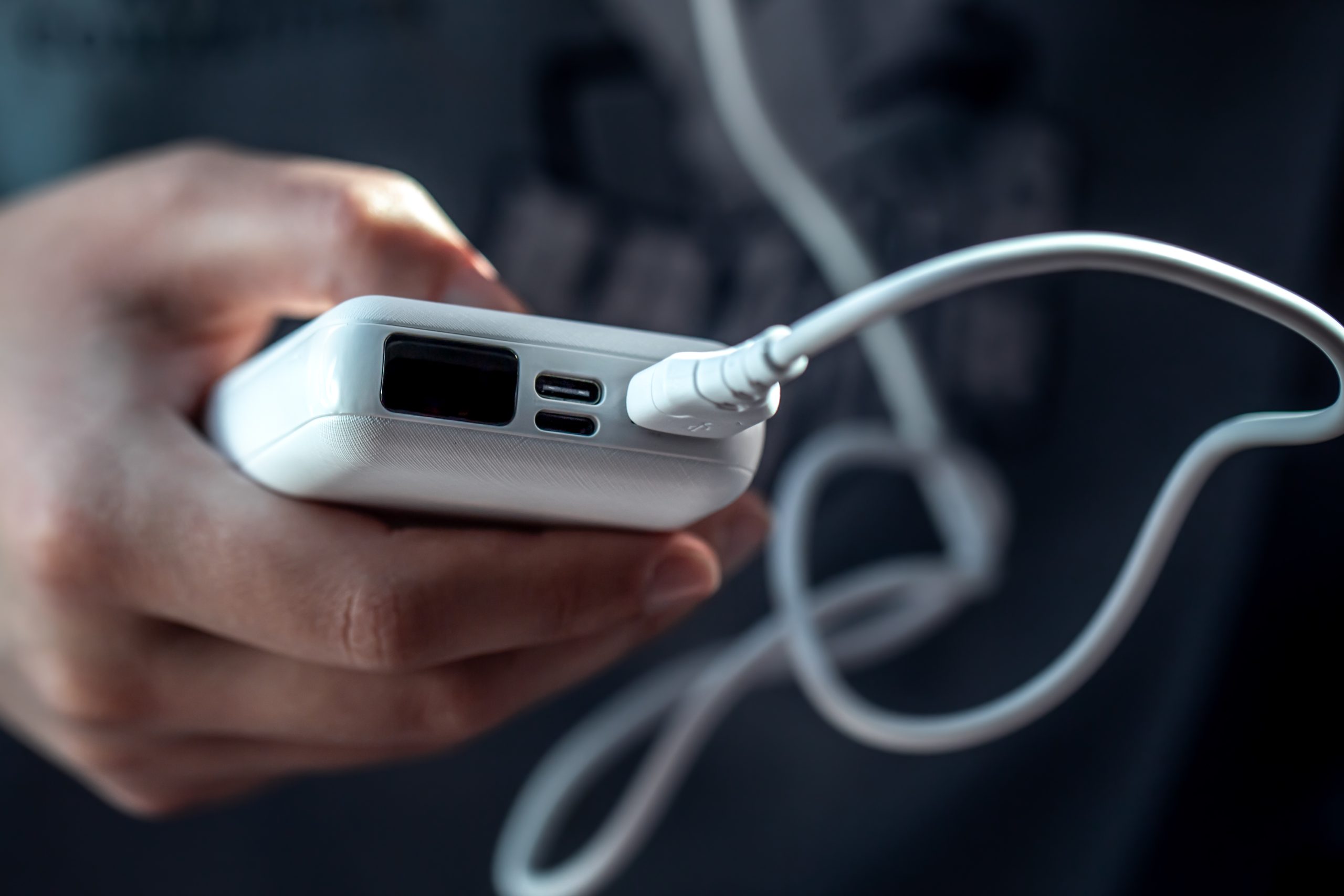

To choose a good quality power bank in the Philippines, check five things before you pay: weight, the label, the output standard, the seller and the price. A genuine 10,000 mAh bank weighs at least 150 g and usually 180–250 g; a real 20,000 mAh bank weighs 300–450 g, so a “20,000 mAh” unit at 200 g has fewer cells than it claims. The label must show Wh (37 Wh for 10,000 mAh, 74 Wh for 20,000 mAh) and a rated capacity at 5V, which honest brands print. For any phone with a USB-C to USB-C cable, look for USB-C Power Delivery of at least 20W. Buy from a brand’s official store on Shopee or Lazada, or from a mall retailer, and treat prices below about ₱450 for 10,000 mAh or ₱700 for 20,000 mAh from unknown brands as a sign of underfilled or recycled cells. Finally, test the bank in the first week, while you can still return it.
The 7-Point Quality Check
| Check | Good quality | Warning sign |
|---|---|---|
| 1. Weight | 10,000 mAh: 150–250 g; 20,000 mAh: 300–450 g | Big mAh number, light body |
| 2. Label | Wh value, rated capacity at 5V, model, manufacturer | Only “20000mAh”, no Wh, no model |
| 3. Output | USB-C PD 20W+ (PPS for Samsung 25W) | “Fast charge” with no protocol listed |
| 4. Input | USB-C, 18W+ for 20,000 mAh banks | Micro-USB only, 10–12 hour recharge |
| 5. Seller | Mall/official store, brand site, mall retailer | New shop, copied photos, no warranty |
| 6. Certification | PS or ICC mark with verifiable QR code | Sticker with no code, or none at all |
| 7. Price | Within normal range for the brand | ₱100–₱400 for “20,000–50,000 mAh” |
The lightest genuine 10,000 mAh bank on the market, the Nitecore NB10000 Gen 2, weighs 150 g thanks to a carbon fiber frame; see our Nitecore review. Anything lighter is suspicious.
Reading the Label Like an Inspector
A good label tells you three numbers. Cell capacity (for example 10,000 mAh 3.7V 37 Wh) is what the cells store. Rated capacity (for example 6,400 mAh at 5V) is what actually reaches your cable; Xiaomi, ASUS and Nitecore print it, and it is normally 55–65% of the cell figure. Output lines (5V 3A / 9V 2.22A) tell you the real maximum wattage: multiply volts by amps. If the box promises 22.5W but the label shows only 5V 2.4A, you will get 12W.
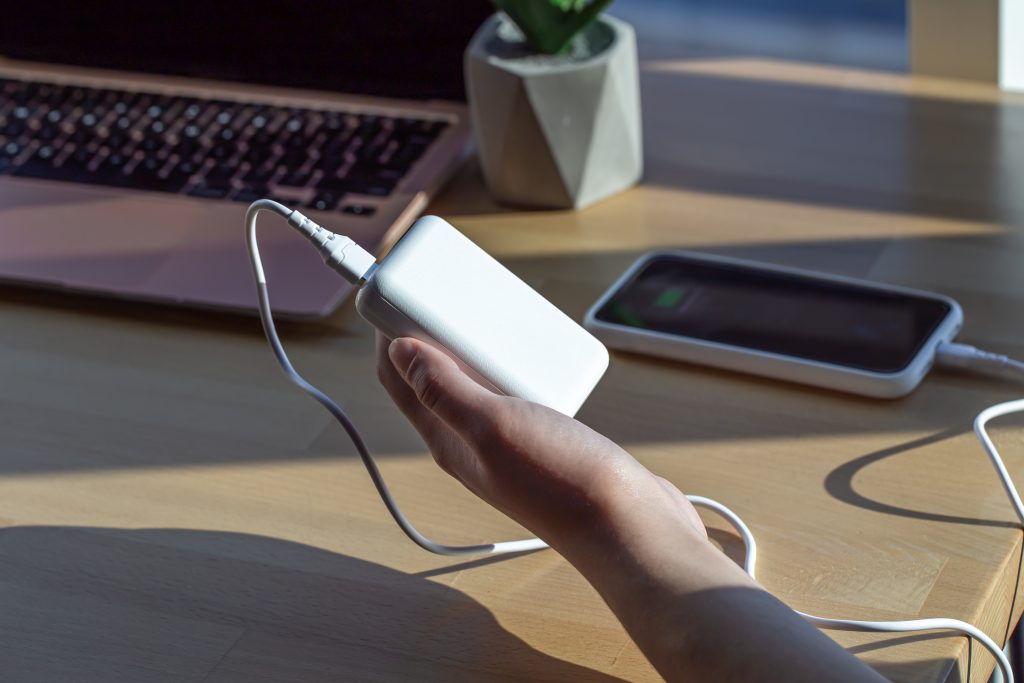
Which Output Standard Your Phone Needs
| Phone | Standard to look for | Useful bank wattage |
|---|---|---|
| iPhone 12–17 | USB-C PD | 20W or more |
| Samsung Galaxy A and S (base) | PD with PPS | 25W PPS |
| Samsung S Ultra, S Plus | PD with PPS | 45W PPS |
| Xiaomi, Redmi, POCO | PD, or Xiaomi’s own protocol for full speed | 18–22.5W PD covers most |
| Older Android, micro-USB | QC 3.0 or standard 5V | 10–18W |
A bank without PPS still charges Samsung phones, but at about 15W instead of 25W. A bank without PD charges iPhones at 12W or less.
The PS/ICC Mark and the 2026 DTI-BPS Draft
On 27 February 2026 the DTI Bureau of Philippine Standards released a draft technical specification that would put power banks and portable power packs under mandatory PS or ICC certification, tested to PNS UL 2056 and UL 2743, with a 12-month transition after it takes effect. Until enforcement is complete, many legitimate imports still carry no mark, so the mark is a strong positive sign but its absence is not proof of a fake. A real ICC sticker has a QR code you can verify; our DTI-BPS certification guide shows how.
Case: Spotting a Fake in Five Minutes
Picture a common buy: a “Xiaomi 30,000 mAh 66W” bank for ₱550 from a Shopee shop opened three months ago. The listing photos are Xiaomi’s own renders, the weight field says 280 g, and the label photo shows “30000mAh” with no Wh and no model number. Each point fails our table: 30,000 mAh cannot weigh 280 g, a genuine Xiaomi label always shows the model code and Wh, and 66W banks with that capacity cost several times more. The likely reality is about 8,000–12,000 mAh of salvaged cells and 10W output. The same money buys a genuine 10,000 mAh 20W Ugreen or a 20,000 mAh Rapoo; see our best power bank under ₱1,000 list.
The same check works in a Cyberzone stall: ask to hold the unit, read the back label in good light and plug it into your phone with your own cable. Sellers of genuine stock rarely object; sellers of copies often refuse to open the box.
Test It in the First Week
- Charge the bank to full with a proper USB-C charger and note the time; a 10,000 mAh PD bank should fill in 3–4 hours.
- Drain your phone to 10–20% and charge it to 100%, counting how many times you can repeat this.
- Compare with realistic numbers: about 2 iPhone 15 charges or 1.2 charges of a 5,000 mAh Android per 10,000 mAh.
- Touch the casing while charging: warm is normal, too hot to hold is not.
- If it falls short by more than 25%, return it within the platform’s return window.
Trusted Brands and Where to Buy
| Tier | Brands | Typical 20,000 mAh price |
|---|---|---|
| Premium | Anker, Ugreen Nexode, Nitecore | ₱1,500–₱2,700 |
| Value | Baseus, Xiaomi, INIU, Vention | ₱800–₱1,900 |
| Budget | Romoss, Rapoo, Orashare (official stores only) | ₱750–₱1,300 |
Our full rankings are in the best power banks in the Philippines guide, and current price ranges in our power bank prices overview.
FAQ
What is a good quality power bank in the Philippines?
One with a clear Wh and rated-capacity label, realistic weight for its mAh, USB-C Power Delivery of 20W or more, and a warranty from a known brand sold through an official store or mall retailer.
How can I check if a power bank is original?
Compare weight with the brand’s official specs, check the model code and Wh on the label, verify the serial or QR code, and buy only from the brand’s official store.
Is it safe to buy power banks from Shopee or Lazada?
Yes, if you buy from LazMall, Shopee Mall or the brand’s official store. Avoid new shops with copied photos and unrealistic prices.
Is a PS or ICC mark required on power banks?
DTI-BPS released a draft in February 2026 to make PS or ICC certification mandatory for power banks. A valid mark with a QR code is a strong sign of a legitimate product.
Why are some power banks so cheap?
They use fewer, recycled or low-grade cells and minimal protection circuits. They deliver far less than the label and are more likely to overheat.
Sources: GMA Labs: Philippines power bank certification draft; Draft PS/ICC certification details (2026); Nitecore NB10000 specifications.

Hi! I focus on power banks, charging systems, and real-world performance — mostly trying to understand why specs don’t always match reality. I enjoy breaking things down in a simple way, even if I overthink them first. In my free time, I hang out with my cat, drink more coffee than I probably should and sometimes forget to charge my phone in time, that is why power banks are my best friends!
3 thoughts on “How to Choose a Good Quality Power Bank in the Philippines (2026): 7 Checks Before You Pay”